
I have recorded a summary of the three recent sessions I ran on AI and higher education, plus a session for university leaders earlier this week in London. I call it a summary, but it’s still 1 hour 15 minutes. (You can jump between the three main sections – teaching, research, engagement – using the timestamps in the video description, or watch it on double speed for super efficiency).
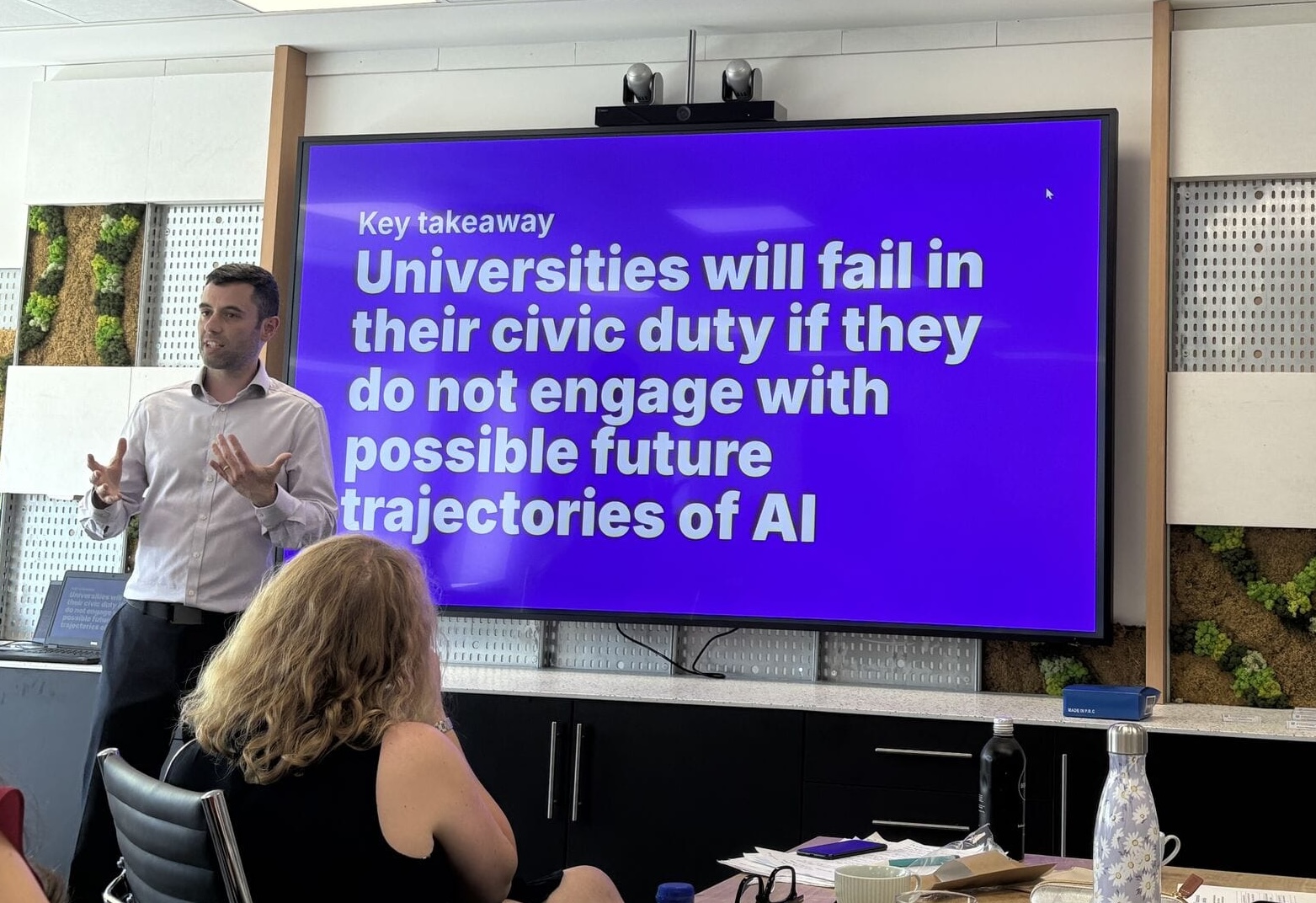
University leaders need to understand how AI could impact society, and in turn themselves. It’s not enough to give annual AI literacy training, alongside your data protection or fire safety training. There’s a need to engage with AI much more strategically and this video sets out how this might be done.
I was inspired by my friend Dr Michael Weatherburn at Imperial who has recorded some of his popular seminars for wider audiences. Part way through my son came into the room and was watching me intently from one meter away, so I sometimes struggle to keep a straight face. But I’m curious whether this format is helpful – and how many of the predictions come to pass over the next few years.
Watch to find out:
- How student use of AI tools jumped from 43% to 92% in less than two years, and what this rapid adoption tells us about higher education’s future
- What common element links successful AI integration case studies from Cornell, Bath, and Sheffield, and why the University of Auckland’s implementation faced backlash
- Why focusing on AI as a cost-cutting measure will ultimately undermine a university’s core mission
- How the growth of ‘AI cognitive labor’ might this transform the fundamental nature of academic research within the next 5 years
- How the development of autonomous ‘AI Scientists’ that can generate research ideas, write code, and publish a paper for less than the cost of lunch will reshape academic publishing
- What it means when researchers who understand AI can direct hybrid AI-human teams while others may be left behind, and how this might create a separation between key researchers and universities
- How AI-enabled research advancements being concentrated in large tech labs rather than universities will have implications for knowledge democratisation
- Why universities need to step up and help prepare society navigate potential transformation (e.g. a century of technological progress within the next 10 years)
- What can a computer game from the ‘90s can tell us about planning for the future.
If you’re interested in me giving a similar talk at your institution, please get in touch.
(Image credit: Hanna Barakat & Cambridge Diversity Fund)


Leave a reply to fascinating0b0e0d747c Cancel reply